
Machined Metal Parts
Machined Metal Parts — aluminum to titanium from Dongguan, China. Tolerances: ±0.003 mm milling, ±0.002 mm turning — ISO 9001 / IATF 16949 verified.
Machined metal parts ship on time when the machine mix matches the geometry.
What are machined metal parts?
Machined metal parts are metal components cut from solid stock — aluminum, steel, stainless, titanium — to a drawing's geometry and tolerance. Their lead time is set by the machine mix: a 5-axis center finishes in one setup what a 3-axis needs several for.
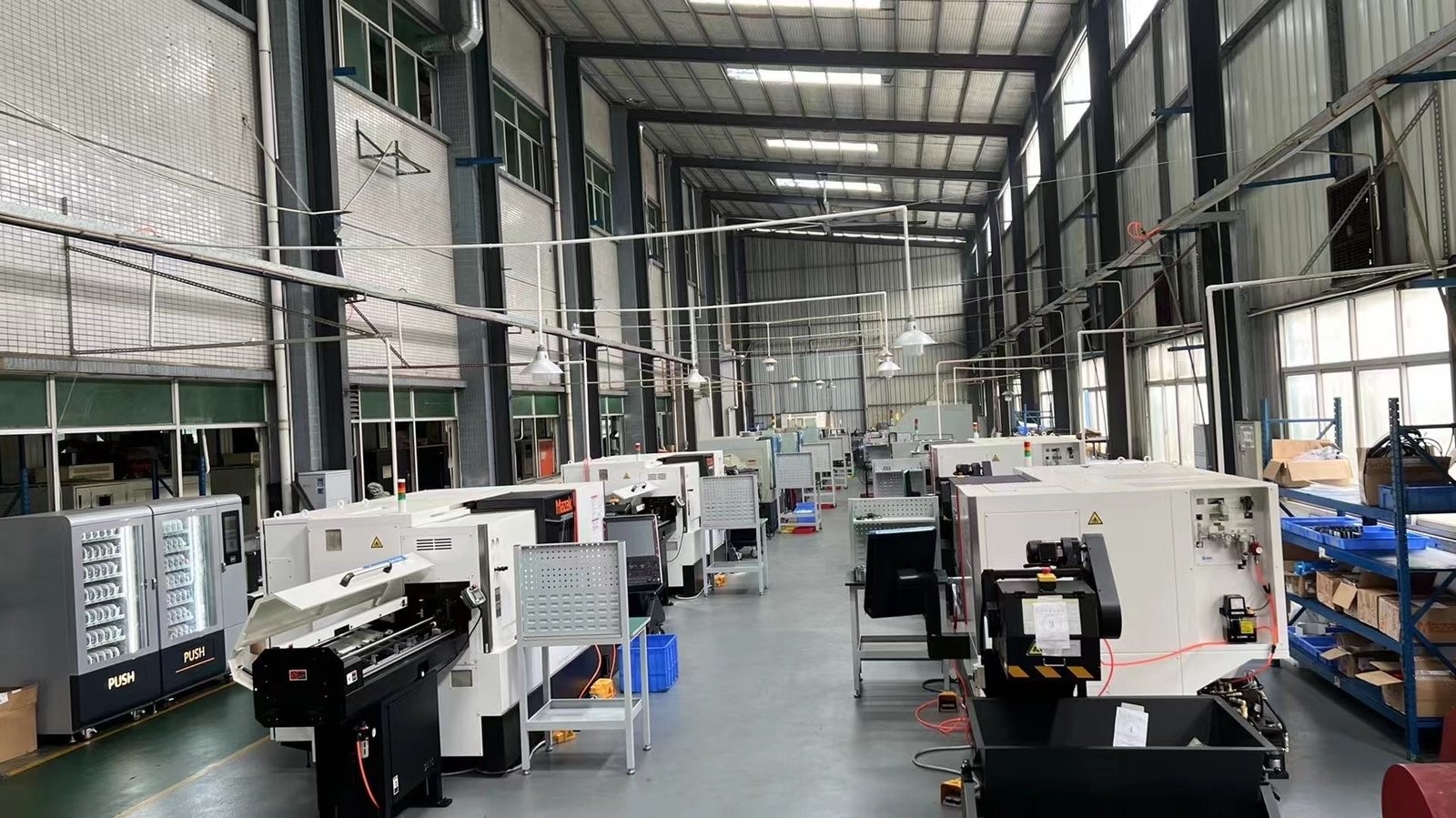
A lead-time promise is only as good as the capacity behind it. Our floor runs 100+ production machines — 3-axis (50+), 4-axis (20+), 5-axis (20+), 25+ lathes, and 7+ grinders — across 6,800 m² with 100+ employees. That breadth means a job routes to the machine that cuts it fastest, and a prototype scales to volume on the same equipment.
Breadth alone does not keep a date — scheduling discipline does. A shop can own 80 machines and still miss a date if it over-commits the spindles. The number worth asking for is not just the machine count but the rule that routes your job: prototype and production share the same equipment, so the process you validate is the process that ships.
Capacity is also a buffer. A shop running every spindle at full load has no way to absorb a rush order or a rework batch; a shop with headroom can re-route without breaking other dates. When you audit a supplier, ask what utilization the floor runs at, not just how many machines are bolted down. Idle capacity is not waste — it is the margin that keeps your date when something else goes wrong.
How does machine mix shorten a lead time?
The right machine mix is what keeps a lead time short. A 5-axis center cuts a complex part in one setup where a 3-axis would need several; a mill-turn lathe holds concentricity on a cross-drilled part without a second operation. Every setup you avoid is a day you save.
| Process | Capacity | Lead-time effect |
|---|---|---|
| 3-axis milling | 50+ centers | Fast for flat, prismatic parts |
| 4-axis / 5-axis milling | 20+ / 20+ centers | Cuts setups on complex parts |
| CNC turning | 25+ lathes | Round parts, up to Ø720 × 1280 mm |
| Mill-turn | Multi-task centers | One setup for concentric parts |
| Grinding | 7+ machines | ±0.002 mm finishes |
The mix matters because setups are the hidden cost of a schedule. Each setup is a fixturing, an alignment, and a first-piece check, and each is time the part is not progressing. A part that needs three setups on a 3-axis can often run in one on a 5-axis, which removes two chances to lose a day. When you compare quotes, ask which machine each operation runs on — a shop that names the machines is telling you it has actually routed the job.
How do secondary operations affect the schedule?
Secondary operations are where lead times quietly stretch. A machined part that needs anodizing, plating, or heat treatment leaves the building for a qualified partner, and that hand-off adds days. We run these in parallel where possible and state the honest total up front, so the date you get is the date that holds.
- Surface finishing: standard and hard anodizing, plating, powder coating, painting, brushing, polishing.
- Heat treatment: vacuum, bright, carburizing, nitriding, stress-relief aging. In-house ovens reach 500 °C; titanium stress relief above that goes to a qualified partner.
The hand-off is the point of failure, not the finishing itself. When a part leaves the floor, it enters a partner's queue, and the partner's schedule is not yours. A shop that discloses which steps are outsourced — and names the partner — is protecting your date. A shop that pretends finishing is instant is planning to explain the slip later.
| Secondary step | What it adds | Schedule effect |
|---|---|---|
| Anodizing (standard / hard) | Cleaning, anodize, seal | Adds days; batch to the finisher |
| Plating (zinc, nickel, chrome) | Pre-clean, plate, post-treatment | Adds days; often outsourced |
| Heat treatment (stress relief, hardening) | Furnace cycle, cool, re-check | Adds days; 500 °C in-house, above that outsourced |
| Painting / powder coating | Mask, coat, cure | Adds days; usually outsourced |
How should a buyer plan capacity with the supplier?
Capacity planning is a two-way street. Tell us your annual volume and your ramp, and we will reserve capacity so production lead times do not surprise you later. If you share the forecast, you get a schedule; if you hide it, you get whatever is left.
Because the same equipment runs prototypes and production, the process you validate on one part is the process that scales, and the lead time you experienced on the prototype is the lead time you can plan on in volume.
Before you commit a forecast, pin the supplier down on three things:
- What happens when your volume spikes? Ask whether reserved capacity is a real allocation or a number on a slide.
- What is the escalation path when a date slips? A schedule without a recovery rule is a wish.
- Who owns the forecast? Confirm the shop re-plans against your numbers rather than filing them away.
What red flags signal a weak lead-time promise?
- One flat lead time for every part. A shop that quotes the same date regardless of complexity has not read the drawing.
- No mention of finishing. A quote that ignores anodizing or plating will slip when the part leaves the building.
- No capacity named. A lead-time promise without a machine count behind it is a guess.
- No named planner. A schedule owned by a shared inbox is owned by no one.
- A date quoted without seeing the drawing. A real lead time is computed, not pulled from a rate card.
How does material choice move a part between lead-time tiers?
Material sets the cutting speed, and cutting speed sets how long a batch occupies a spindle. A part in free-machining aluminum clears a machine far faster than the same geometry in titanium, so the material alone can push a job from the 7-day tier into the 30-day tier — even when the drawing is identical.
The mechanism is machinability. Soft, free-cutting alloys break chips cleanly, run at high feed, and wear tools slowly. Hard or work-hardening alloys run slower and wear inserts faster, which means more tool changes and more spindle time per part. That difference compounds across a production run.
| Material | Machining behavior | Lead-time effect |
|---|---|---|
| Aluminum 6061 / 7075 | Fast feeds, sheds heat well | Shortest; often the ~3–7 day tier |
| Free-machining brass (C360) | Clean chips, fine threads run fast | Short; tight bores hold well |
| Carbon / leaded steel (12L14, 1045) | Predictable chip, moderate tool wear | Mid; standard tier |
| Stainless 304 / 316 | Work-hardens as it cuts | Slower feeds; longer than aluminum |
| Titanium TC4 | Holds heat at the edge, slow feeds | Longest; plan the 30-day tier |
The practical move is to pick the grade that earns its keep. A drawing that calls for stainless where aluminum would function is paying for corrosion resistance in machine time, not just in stock cost. Flag the material early, and the shop can tell you honestly which tier the part lands in.
How do tolerance and surface finish stretch or compress a schedule?
Tolerance and finish are schedule levers, not just print callouts. A feature at ±0.05 mm machines in one pass; a feature at ±0.003 mm (milling) / ±0.002 mm (turning) may need a finishing pass or a grind, and a ±0.002 mm surface needs a grinder. Each tightening adds an operation, and each operation adds a queue.
Surface finish works the same way. A machined face at Ra 3.2 µm needs only a standard milling pass; Ra 1.6 µm needs a finer pass; Ra 0.8 µm may need grinding or a second process. The finish you call out is a delivery-date decision disguised as a drawing note.
| Ra target | Typical process | Schedule effect |
|---|---|---|
| 3.2 µm | Standard milling / turning | No extra step; shortest |
| 1.6 µm | Fine milling / turning pass | One extra pass |
| 0.8 µm | Grinding or honing | Adds a finishing operation |
| 0.4 µm or finer | Precision grinding / lapping | Longest; adds a dedicated step |
Before you tighten a tolerance or a finish, ask what it buys. If the tighter callout does not change function, it only adds cost and time. The cheapest way to shorten a date is often to loosen a dimension that never needed to be tight.
What DFM decisions shorten a lead time before quoting?
The design is the schedule's first draft. A part designed for the machine it will run on needs fewer setups, fewer tools, and less rework, and that shows up as a shorter, more reliable date. Design-for-manufacturability is not a formality; it is how you buy back lead time before a chip is cut.
| DFM rule | Why it shortens the schedule |
|---|---|
| Relax internal corner radii; avoid sharp internal corners | Lets a standard end mill run; no extra small-tool pass |
| Keep wall thickness above a workable minimum | Prevents chatter and deflection that force slower feeds |
| Limit deep pockets and deep holes | Avoids long-reach tools that deflect and break |
| Use standard thread sizes | Standard taps are on the shelf; odd threads are a special order |
| Specify tolerances only where function demands | Fewer finishing passes and less inspection |
A shop that returns a DFM review before quoting is doing you a favor. It catches the sharp corner or the impossible tolerance while the design is still cheap to change, and the fixes it proposes are exactly the ones that pull the job back into a faster tier.
How does a prototype schedule differ from a production schedule?
A prototype is a learning run; a production run is a repetition. The prototype carries the setup cost, the toolpath proofing, and the first-article inspection, so its lead time reflects discovery, not steady state. The production run should be faster, because the learning is banked — same fixture, same program, same machine.
That is why a 1-piece MOQ matters. It lets you validate the part and the process before you commit volume, on the same equipment the production run will use. The lead time you measure on the prototype is then the lead time you can plan on in production, not a different number from a different line.
The trap is a supplier that prototypes on one line and produces on another. When the two differ, the validated date does not transfer, and the first production batch re-learns everything. Ask whether the prototype and production processes are the same — if they are not, your prototype date was a laboratory result, not a forecast.
Why is scheduling discipline worth more than a machine count?
A machine count is a photograph; scheduling discipline is a process. Eighty machines loaded without a plan will still miss dates, because every job waits behind every other job. A smaller shop with a real scheduling rule — capacity reserved, operations sequenced, rework queued ahead — will often beat it.
The discipline shows up in three places. The shop routes each operation to the fastest machine for it, so a complex part does not camp on a 3-axis when a 5-axis is free. It reserves capacity against a forecast, so a spike in someone else's order does not push yours. And it has a recovery rule, so when a date does slip, the shop knows which job to pull forward and which to hold.
When you audit a shop, ask to see the schedule, not just the floor. A shop that can show you where your job sits and what protects it is a shop that can keep a promise. A shop that points at the machines and smiles is hoping you will not ask.
How do you read a lead-time quote like an engineer?
A lead-time quote is a claim you can test. The honest one names the tier, the process steps behind it, the finishing route, and the capacity behind the date. The weak one is a single number with nothing behind it. Here is the checklist to run before you accept either.
- Does it name the tier and the reason? "3 days because two operations, no finishing" is a routing; "3 days" alone is a guess.
- Does it account for finishing? If the part needs anodizing, the date must include the hand-off, not end at the machine.
- Is the capacity named? A date backed by a machine mix and a planner is a forecast; a date with no floor behind it is a wish.
- What is the recovery rule? Ask what happens if the date slips, and get the answer in writing.
- Who owns the date? A named planner, not a shared inbox.
When does an honest lead-time promise still fail?
Even a shop that plans honestly can miss a date, and knowing the failure modes keeps them from becoming surprises. The point of this list is not to excuse slips — it is to tell you where to put your own buffer and what to watch.
- Material that fails incoming check. A rejected lot restarts the clock; ask whether the shop holds buffer stock for your grade.
- A fixture that was wrong the first time. First-article rework burns the schedule's front end; ask how the shop verifies fixturing before cutting.
- An outsourced step that runs late. The partner's queue is the shop's risk, not yours; ask who owns the partner's date.
- A rush order that jumps the queue. Reserved capacity should protect your date from other people's emergencies.
None of these are secrets a good shop hides. Ask about them up front, and the shop that answers cleanly is the one whose date you can actually plan against.
Where does the delivery date end — at the factory gate or your dock?
A lead time means nothing until you fix where the clock stops. If the date is ex works, it ends when the parts leave the factory gate in Dongguan; freight, customs, and final delivery are yours. If it is delivered, the shop owns the whole leg. The two numbers can differ by days or weeks.
Incoterms are the shorthand for where cost and risk transfer between buyer and seller. EXW (ex works) puts the goods in your hands at the gate; FOB (free on board) gets them onto the vessel; CIF adds insurance and freight to the destination port; DAP delivers to a named place. None of these change the machining time — they change what "delivered" means, and therefore what date you actually plan your assembly against.
| Term | Where the clock stops | Who owns the rest |
|---|---|---|
| EXW | Factory gate | Buyer arranges and owns freight, insurance, customs |
| FOB | Loaded on the vessel at origin | Buyer owns freight and insurance after loading |
| CIF | Destination port, freight and insurance paid | Buyer owns customs and inland delivery |
| DAP | Named destination place | Buyer handles import clearance |
Confirm the term when you confirm the date. A machining lead time of 7 days plus a 21-day sea leg is a 28-day arrival, and neither the shop nor the carrier is lying — they are just counting different clocks.
How does workpiece size change a lead time?
A large part changes the schedule in two ways. It needs a machine with enough travel and a table that can hold it, which is a smaller pool than the general floor, so it may wait longer for a specific spindle. And it needs more careful fixturing, because a big part deflects more and takes longer to indicate in. Size is not a cost driver alone; it is a scheduling constraint.
| Workpiece | Capacity | Schedule effect |
|---|---|---|
| Milling envelope | 1300 × 700 × 600 mm | Most prismatic parts fit a standard center |
| Turning envelope | Ø720 × 1280 mm | Long shafts run on the larger lathes |
| Small / micro parts | Standard centers | Fast setups, quick cycles |
| Large plate or frame | Dedicated larger center | Fewer machines qualify; plan the longer tier |
you should ask whether the part fits the shop's standard envelope or needs a special machine. If it needs a special machine, the shop's answer about the date tells you whether that machine is actually available or merely listed.
How do order quantity and batch size affect the schedule?
Batch size changes where the time goes, not just how long the job runs. A single prototype spends most of its time in setup; a production run spends most of it in cutting and inspection. The setup is paid once, so the per-part lead time drops as the batch grows — up to a point, where inspection and material handling become the bottleneck.
A 1-piece MOQ lets you split the difference: prove the part on one piece, then commit the batch. The shop that lets you validate first, without a minimum, is the one that understands the prototype is a learning run, not a volume bet.
| Quantity | Where time goes | Schedule profile |
|---|---|---|
| 1–5 pieces | Setup, toolpath, first article | Prototype tier; discovery dominates |
| Small batch | Cutting plus in-process checks | Standard tier; setup amortized |
| Volume run | Cutting, inspection, handling | Planned against reserved capacity |
How does tooling and fixturing change the schedule?
Fixtures are the part of the schedule you never see. A soft-jaw setup can run the same day; a custom fixture that must be designed, cut, and proven adds its own lead time to the part's. The same is true of special tooling — a form tool or a long-reach cutter that is not on the shelf has to be ordered before the part can start.
The honest shop separates tooling lead time from machining lead time and tells you both. The dishonest one buries the tooling wait inside the machining date and hopes you will not notice when the start slips.
| Tooling item | When it is ready | Schedule effect |
|---|---|---|
| Standard tools (end mills, taps, inserts) | On the shelf | No added time |
| Soft jaws / simple fixture | Cut in-house, same day | Minimal added time |
| Custom fixture | Designed and cut to order | Adds days up front |
| Special form tool | Ground by a tooling partner | Adds days; plan the longer tier |
Which tolerance standard applies when the print is silent?
When a drawing says nothing about general tolerances, the shop and the buyer need a default, or they will argue about what "good enough" means. ISO 2768 is the common default for machined parts: it grades general tolerances into classes — fine (f), medium (m), coarse (c) — that set the allowed deviation by nominal size without a tolerance on every dimension.
A print that calls out ISO 2768-m tells the shop the general tolerance class, and the shop can machine to it without asking. A print that is silent leaves the class open, which is how a perfectly good part becomes a rejection. Specify the class, or the shop will assume one you did not intend.
| ISO 2768 class | Meaning | Use |
|---|---|---|
| Fine (f) | Tight general tolerances | Precision parts, fits |
| Medium (m) | Standard general tolerances | Most machined parts |
| Coarse (c) | Loose general tolerances | Non-critical features, weldments |
This is standard engineering reference data, not a shop-specific claim, but it matters to the schedule, because the class you pick determines how much care every un-dimensioned feature gets.
What material properties drive the machining schedule?
Two properties decide how a material behaves in the cut: hardness and work-hardening behavior. Hardness sets the tool load and the feed; work-hardening sets whether the material gets harder the moment the tool touches it. Together they determine the cycle time, and cycle time is the schedule.
| Alloy | What it is used for | Machining note |
|---|---|---|
| 6061-T6 aluminum | Housings, brackets, general parts | Cuts fast; the default for prototypes |
| 7075-T6 aluminum | High-strength aerospace and structural parts | Strong, slightly slower than 6061 |
| 304 stainless | Corrosion-resistant parts | Work-hardens; slower feeds |
| 316 stainless | Marine and chemical environments | Work-hardens; harder than 304 |
| 4140 alloy steel | Shafts, gears, high-stress parts | Machines well annealed; hardens after |
The schedule follows the property, not the name. Two alloys with similar names can machine a day apart, which is why the shop asks for the exact grade before it commits to a date.
How do you audit a capacity claim before committing?
A capacity claim is easy to make and cheap to fake. A real one is checkable in a fifteen-minute conversation. Run these questions and watch which ones the supplier answers with a number and which ones it answers with a story.
- Name the machines. Ask for the actual models and counts, not "we have many machines."
- Show the schedule. Ask where your job sits and what protects it.
- Name the planner. A schedule owned by a person, not an inbox.
- Show a real CMM or SPC chart. A measured result beats a capability statement.
- Name the finishing partner. If finishing is outsourced, the shop should say who does it.
A shop that clears all five has earned the date it quoted. A shop that stalls on any of them has told you something useful — at a fraction of the cost of finding out after the order is placed.
How do you keep a repeat order on schedule?
The first order pays for the learning: the program, the fixture, the operator who found the tolerance. A repeat order should be faster and steadier, because that learning is banked. The difference is whether the shop keeps your fixture, your program, and your inspection plan on file, or treats every reorder as a new job.
A shop that keeps your setup reproduces the part without re-learning it, which holds the lead time short and the variation low. A shop that loses that continuity charges you for the learning again — in the price, in a slower ramp, or in the scrap that comes with a fresh start.
Ask what happens on the second order before you place the first. The answer is a forward price on your future schedule, and it sits on the same ledger as the cost of switching suppliers.
How does inspection sit inside the schedule?
Inspection is part of the lead time, not a step after it. Every critical dimension gets measured, and that measurement takes clock time — a CMM program, a first-article report, an SPC chart. A shop that builds inspection into the schedule ships a date that includes it; a shop that treats inspection as a surprise ships a date that slips at the dock.
The smart shop inspects in parallel with the run — first article at the machine, in-process checks at intervals, final report before boxing — so inspection does not sit as a dead block at the end. Ask when the first article is measured, not just whether a CMM exists.
| Inspection point | When it runs | Schedule effect |
|---|---|---|
| First article | At the machine, before the full run | Catches setup error early |
| In-process | At intervals during the run | Catches drift before the batch ends |
| Final report | Before boxing | Proof the batch is good |
How do cross-industry demands reshape a schedule?
Different buyers stress different parts of the schedule, and the shop's job is to know which stress is yours. A robotics program wants tight bores and repeatability across thousands of pieces; a medical program wants clean documentation and traceability on every lot; an e-bike drivetrain wants concentricity and a gear-tooth finish that survive vibration. Each one pulls a different lever on the same calendar.
The common thread is that the schedule has to hold under a specific kind of pressure. If you name the pressure — traceability, repeatability, finish, or volume — you let the shop plan for it. If you say only "machined parts", you leave the shop to guess, and a guess is how a date goes wrong.
Across the industries this floor serves — automotive, medical devices, robotics, semiconductor tooling, e-mobility — the capacity is the same, but the sequencing changes. A part that runs in one setup on a mill-turn, or that needs SPC on a key characteristic, is planned differently from a one-off bracket. Match the demand to the machine, and the date holds.
How do you shorten a date without sacrificing quality?
There are only three honest ways to pull a date forward, and none of them involve asking the shop to hurry. You can remove a process step, loosen a callout that does not change function, or reserve capacity earlier. Everything else is either a lie or a gamble.
Removing a step means dropping a finishing operation or a redundant setup. Loosening a callout means asking whether a ±0.003 mm (milling) / ±0.002 mm (turning) dimension really needs it, or whether ±0.05 mm would work. Reserving earlier means committing the forecast so the shop holds the spindle. Each of these shortens the schedule by removing work, not by asking someone to work faster.
The wrong way is to compress the machining time itself. A shop that agrees to machine faster than the material allows is planning to skip a pass or a check, and the part that shows the result of that skip arrives on time but wrong. The date that matters is the date a good part arrives, not the date a box leaves.
What does "capacity" actually measure — machines, people, or floor?
Capacity is three things, and buyers usually only ask about one. The machines set how many spindles are cutting at once. The people set how many setups, programs, and inspections happen in a day. The floor sets whether material, work-in-progress, and finished parts can move without blocking each other. A shop that can only name the machine count has measured a third of its capacity.
People are the quiet constraint. A shop with 80 machines and not enough programmers or inspectors will idle its spindles waiting for the next setup or the next report. The machine count looks impressive; the throughput does not. When you audit, ask how many people set up, program, and inspect, not just how many machines sit on the floor.
The floor matters too. 6,800 m² means a job can stage without clogging the aisle, and a large part has room to sit while it waits for its machine. A cramped floor turns every hand-off into a traffic jam, and traffic jams show up as late dates. Capacity is the whole system, not the spindle count.
How do you compare two lead-time quotes fairly?
Two quotes that both say "7 days" are not the same promise. One includes finishing, the other ends at the machine. One is backed by reserved capacity, the other is a number typed into an email. Comparing them fairly means lining up what each date actually covers.
| What to align | Why it changes the comparison |
|---|---|
| Does the date include finishing? | Anodizing or heat treatment adds days one quote may hide |
| Where does the clock stop? | Ex works vs delivered can differ by weeks |
| What capacity is reserved? | A real allocation vs a wish changes the odds |
| What is the recovery rule? | One shop has a plan for a slip; the other does not |
| Who owns the date? | A named planner vs a shared inbox |
Normalize the two quotes against these five lines and the difference between them stops being a number and becomes a decision. The date you can plan against is the one that survives the comparison, not the one that looks shortest on paper.
How do you phase a project so the schedule never blocks assembly?
Assembly waits for the longest part, not the average part. If your product needs ten machined components and one of them lands in the 30-day tier, that one part sets your build date — the other nine can arrive in three days and still sit in a box. Phasing the order so the long-lead part starts first is how you stop one straggler from holding the whole line.
The simple discipline is to sort the bill of materials by tier before you place anything. Start the complex, finished, or oversized parts immediately; let the simple brackets and spacers follow. The shop can help — a real shop will flag which part is the schedule driver the moment it sees the drawing set.
If you phase this way, you turn a delivery risk into a plan. The long part gets the schedule it needs, the short parts fill the gaps, and the assembly date stops being hostage to the slowest drawing.
What should the first email to a shop contain?
The faster a shop understands your part, the faster it can return a real date. The drawing is the start, but three lines of context turn a quote into a plan: the material and finish, the quantity and ramp, and the date you actually need.
- The drawing. STEP, IGES, or a 2D PDF. A model beats a sketch because it carries the geometry without ambiguity.
- The material and finish. Grade, surface finish, and any heat treatment, so the shop prices and plans the right route.
- The quantity and ramp. Prototype count now, annual volume later, so capacity can be reserved.
- The target date. State the real need, and the shop can tell you whether it holds.
A complete first email gets a DFM review, a quote, and a lead-time estimate in one reply. An incomplete one starts a thread of questions, and every round-trip costs a day on the calendar.
How does a material certificate sit inside the schedule?
Incoming material is verified against its mill certificate before a chip is cut, and that verification is part of the schedule, not a formality. A lot that arrives without a cert, or fails the XRF check against it, restarts the clock — the shop re-orders or re-checks, and the date moves. Catching the problem at the door is what keeps a material issue from becoming a late shipment.
The cert also travels with the parts, so you can tie a finished batch back to a heat number. That traceability is not paperwork for its own sake; it is how a recall, if one ever happens, is contained to one lot instead of every lot. For regulated buyers, the cert is not optional — it is the difference between a shipment you can accept and one you cannot.
Guides
- Machined metal parts cost in 2026 — your cost model where the route and the date come from the same page.
What this shop actually runs

A buyer asking for capability evidence should get a specific answer. The facility behind this guide operates 100+ CNC machines across a 6,800 m2 plant in Dongguan, China, with 100+ staff. The machine list by category:
- 5-axis machining centres (10+) - Mazak VARIAXIS I-600 (510/910/510 mm travel, 12,000 rpm, 22 kW, 71.6 N·m, 30-tool BT40) and Mazak INTEGREX I-250H S (B-axis 0.0001°, 24 kW, 124 N·m, 38-tool HSK-A63). Meant for compound-angle parts, single-setup multi-face prismatic work, and aerospace fittings where datum transfer loss is unacceptable.
- 3-axis / 4-axis machining centres (50+) - Brother SPEEDIO S500Z2N / S700Z2N (10,000 rpm, 14/21-tool ATC, 0.7 s tool-to-tool, Z-axis 2.2 G) and Mazak VCE-430A L / VCE-570C L (10,000 rpm, 118 N·m, 24-tool ATC). Meant for prismatic parts, plates, brackets, housings.
- A 6,800 m² floor of named equipment — Mazak, Brother, Tsugami, Star and Citizen machines (3-axis 50+, 4-axis 20+, 5-axis 20+, 25+ lathes, 7+ grinders, 20+ inspection instruments).
- Tolerance: ±0.002 mm, verified on Hexagon CMMs. Capability is reported per characteristic: Ppk ≥ 1.67 in the initial study and Cpk ≥ 1.33 in production on key and special characteristics (≥ 1.33 on general characteristics). Every report names the feature, its tolerance band, the sample size, the sigma method, and the study window.
- Certified under ISO 9001:2015, IATF 16949:2016 (design excluded) and ISO 14001:2015 — Dongguan Zhuohang Ltd is the invoicing entity behind them.
- Order terms: a one-piece minimum and lead times around 3, 7 or 30 days, set by part complexity.
- Machine highlights - VARIAXIS I-600: one-setup multi-face 5-axis + MAZA-CHECK auto-calibration; INTEGREX I-250H S: DONE-IN-ONE mill-turn, B-axis 0.0001° + Ai thermal shield; SPEEDIO S500Z2N / S700Z2N: Z-axis 2.2 G + 0.7 s ATC; Swiss-type: guide-bush switchable + 0.1 µm resolution.
Tolerance bands held: ±0.003 mm on CNC milling, ±0.002 mm on CNC turning, ±0.002 mm on precision grinding and wire EDM. Capability indices: Ppk >= 1.67 initial on key characteristics; Cpk >= 1.33 ongoing in production.
Certifications: ISO 9001:2015 (116024/A/0001/UK/En), IATF 16949:2016 (131941/A/0001/SM/En, design clause 8.3 excluded - disclosed openly), ISO 14001:2015 (116024/B/0001/UK/En). Certificates are issued to Dongguan Zhuohang Ltd (USCC 91441900MA4UWT6X39, established 2005).
Service area: Austria, Belgium, the Czech Republic, Denmark, France, Germany, Greece, Hungary, Ireland, Italy, the Netherlands, Spain, Sweden and the United Kingdom in Europe; Brazil, Canada, Mexico and the United States in the Americas; China, Israel, Japan, Singapore and Sri Lanka in Asia; Australia and New Zealand in Oceania; and South Africa in Africa. Based in China, serving customers worldwide.
Contact: Felipe Iglesias, [email protected], +86 13126536955.
Get a lead-time estimate tied to your process steps
Send your drawing to [email protected] or call +86 13126536955 for a DFM review, quote, and honest delivery date.
Frequently Asked Questions
How are lead times for machined metal parts set?
In short, Lead time follows part complexity and the number of process steps, not a blanket promise. Roughly 3, 7, or 30 days: simple single-material parts ship in about 3 days, standard parts in about 7, and parts with 10–20 operations or surface finishing land in the 30-day tier.
What capacity backs the lead times?
A 6,800 m² facility with 100+ production machines — 3-axis (50+), 4-axis (20+), 5-axis (20+), 25+ lathes, and 7+ grinders — plus 100+ employees, so prototype and production volumes run on the same equipment.
What tolerances can machined metal parts hold?
±0.003 mm on CNC milling, ±0.002 mm on CNC turning, and ±0.002 mm for precision grinding. Critical dimensions are verified on Hexagon CMMs, with Ppk ≥ 1.67 at the initial study on key characteristics and ≥ 1.33 on general characteristics.
What is the minimum order quantity?
One piece. There is no forced production minimum, so you can machine a prototype, validate it, and scale into production on the same drawing and process.
Which materials can be machined?
Aluminum, stainless steel, carbon and alloy steel, brass, copper, titanium, and magnesium, plus engineering plastics. Incoming bar is XRF-checked against the mill certificate before machining.
How does material choice affect lead time?
Material sets the cutting speed. Free-machining aluminum and brass clear a spindle far faster than work-hardening stainless or titanium, so the material alone can move a job from the 7-day tier into the 30-day tier even on an identical drawing.
How do surface finishing and heat treatment affect the date?
In short, Any finishing step pushes a part into the longer tier, because the part leaves the building for a qualified partner. Anodizing, plating, painting, and heat treatment each add a hand-off, and the honest total is stated up front rather than discovered after the date slips.
Can I shorten a lead time by changing the design?
In short, Yes. Relaxing internal corner radii, avoiding deep pockets and holes, using standard thread sizes, and tightening tolerances only where function demands removes setups and finishing passes, which pulls a job back into a faster tier before a chip is cut.
How do I get a lead-time estimate and quote?
Email your STEP, IGES, or 2D drawing to [email protected]. The reply includes a DFM review, an itemized quote, and a lead-time estimate tied to the part's actual process steps.
Where does the delivery date end?
In short, It depends on the Incoterm. Ex works ends at the factory gate; FOB ends when the goods are loaded on the vessel; CIF and DAP extend the clock further.
What is ISO 2768?
In short, ISO 2768 is a standard for general tolerances when a print does not call out a tolerance on every dimension. Its classes — fine (f), medium (m), and coarse (c) — set the allowed deviation by nominal size, so the shop knows the default precision to work to.
How does batch size affect the schedule?
In short, A single prototype spends its time in setup and first-article inspection; a production run spends it in cutting and in-process checks. Because the setup is paid once, the per-part lead time falls as the batch grows, up to the point where inspection and material handling become the bottleneck.
Can I visit the factory before ordering?
Yes. A factory visit is the strongest due-diligence step you can take. Contact [email protected] to arrange a tour of the floor, the inspection bench, and the quality records.
Do you use MIL-STD-105E or ANSI/ASQ Z1.4 sampling inspection?
In short, MIL-STD-105E is the U.S. military sampling inspection standard published in 1989; it specifies acceptable quality limit (AQL) sampling plans for lot-by-lot inspection.
Standards referenced on this page
- ASTM B211/B211M-19 — Standard Specification for Aluminum-Alloy Rolled or Cold Finished Bar, Rod, and Wire
- ASTM B348/B348M-21 — Standard Specification for Titanium and Titanium Alloy Bars and Billets
- ISO 9001 — Quality management systems — Requirements